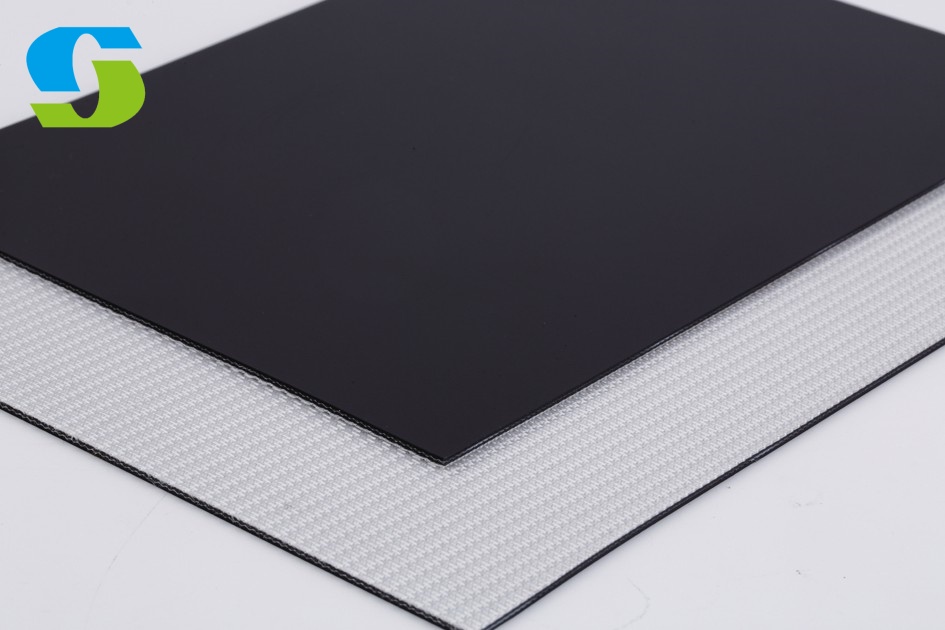
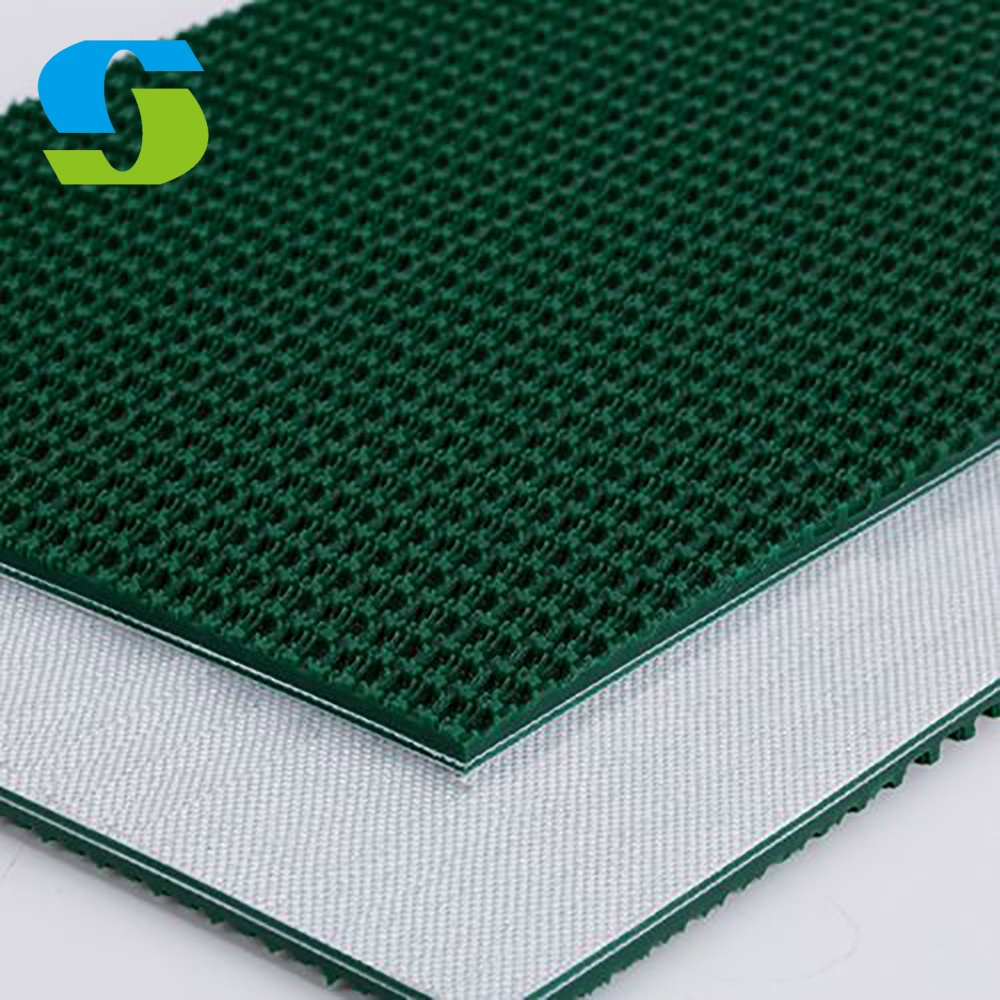
In a renovation project of a German-funded food factory, a thorny problem was faced: when conveying high-humidity pastries, the traditional flat belt slipped and stopped 15-20 times per hour, resulting in an average daily production capacity loss of 8%. After trying to replace it with a PVC Y-pattern belt, the problem that had troubled the production manager for half a year was solved – three months of actual test data showed that the slip frequency dropped to less than 1 time per hour. Such real cases reveal a core fact: efficiency breakthroughs in the field of industrial transportation are often hidden in seemingly ordinary belt pattern designs.
The engineering nature of PVC Y pattern belts
1.1 The golden triangle rule of pattern design
The core competitiveness of the Y-pattern comes from the three-dimensional optimization of “contact area × angle × pressure”. According to our test data in the laboratory, the Y-pattern with an angle of 60° has a 62% increase in friction coefficient (from 0.31 to 0.51) under the same load compared with the flat belt. This improvement is not a simple geometric superposition, but a simulation of the natural grasping structure through the principle of bionics – an array of suction cups similar to octopus tentacles, forming a multi-point bite effect at the microscopic level.
In the actual test of an automobile parts factory in Ningbo, we compared three mainstream patterns:
- Traditional diamond pattern: friction coefficient 0.42, suitable for block materials in a dry environment
- Straight line pattern: friction coefficient 0.38, suitable for rough surface particle transportation
- Y-type pattern: friction coefficient 0.58, outstanding performance in wet and inclined (above 20°) scenes
1.2 PVC material formulation philosophy
Industrial-grade PVC is not a single material, but a precisely formulated composite system. Take the acid-resistant formula we customized for the chemical industry as an example:
- Chlorinated polyethylene (CPE): Improves chemical corrosion resistance and can withstand liquid erosion at pH 2-13
- Nano silicon dioxide: Evenly dispersed in the substrate, reducing the wear resistance index from 120 mg/1000 times to 85 mg/1000 times
- Antioxidant 1010: Inhibits molecular chain breakage at high temperatures and ensures that the performance degradation is < 15% after 5000 hours of continuous operation at 80°C

Scenario-based application: Adaptation logic from micron level to ton level
2.1 “Gentle grip” demand in the food industry
In the croissant production line of a baking company in Hangzhou, we encountered a special challenge: the surface humidity of freshly baked bread reached 85%, and ordinary belts were very easy to stick and break when conveyed. The customized solutions developed for this purpose include:
- Reducing the pattern height: from the standard 3mm to 1.8mm, reducing the indentation on the bread surface
- Rounded edge treatment: the radius of the fillet is increased from 0.8mm to 1.5mm to avoid scratching the puff pastry
- Softening of the material: Shore hardness is reduced from 75A to 60A, and the contact stress is reduced by 30%
This solution reduces the bread breakage rate from 4.2% to 0.7%, and the FDA-certified white PVC material meets the requirements of clean production – daily cleaning time is reduced from 90 minutes to 40 minutes.
2.2 “Hard-core pressure-resistant” design for heavy industrial scenarios
In the transformation of the conveying system of a rare earth mine in Baotou, we faced extreme working conditions:
- Material characteristics: rare earth ore with an average particle size of 50mm, containing 35% quartz sand (Mohs hardness level 7)
- Ambient temperature: -25°C in winter, +40°C in summer, and a temperature difference of 65°C between day and night
- Conveying distance: 800 meters one way, climbing angle 18°
The solutions designed for this purpose include:
- Pattern reinforcement: An 8mm high serrated Y-shaped pattern is adopted, and 3 layers of polyester reinforcement are added to the bottom
- Cold-resistant modification: 30% acrylic rubber (ACM) is added to ensure flexibility at -20°C
- Antistatic treatment: The surface resistivity is controlled at 10⁶-10⁹Ω to avoid transmission deviation caused by mineral powder adsorption
After the implementation of this project, the service life of the belt has been extended from 4 months of ordinary rubber belts to 14 Months, annual maintenance costs have been reduced by 280,000 yuan.
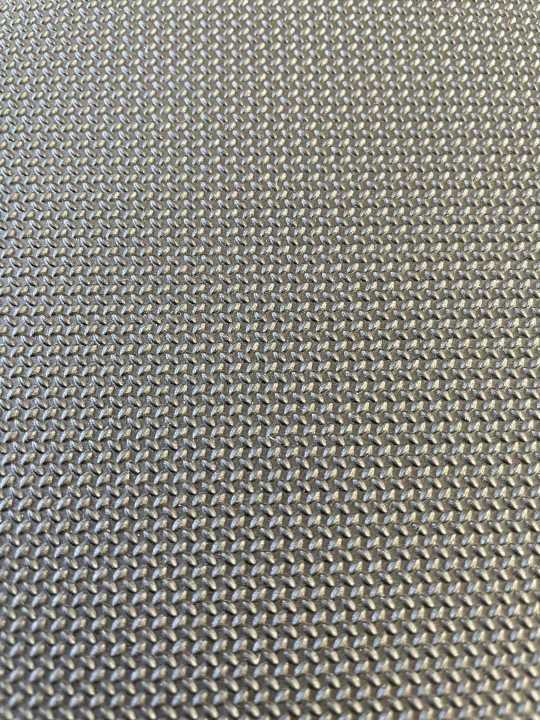
Three-dimensional evaluation model for purchasing decisions
3.1 Five dimensions of the working condition portrait
| Model | 素材 | Surface Pattern | カラー | Thickness | Width | 耐熱温度 | 申し込み |
|---|---|---|---|---|---|---|---|
| PVC-Y01 | PVC | Y-pattern | グリーン | 5 mm | up to 2000 mm | -10°C から +80°C | Marble cutting, polishing, and conveying |
| PVC-Y02 | PVC | Y-pattern | Dark Green | 6 mm | Customizable | -10°C to +90°C | Stone slab processing line |
| PVC-Y03 | PVC | Y-pattern | グリーン | 4 mm | Standard: 1500 mm | -15°C to +70°C | Industrial conveyor systems |
3.2 Three priorities for customization
Based on the service experience of 120+ customers, customization requirements can be ranked according to the following priorities:
- Safety compliance: The food and pharmaceutical industry gives priority to FDA/EC 1935 certification, and the chemical industry focuses on corrosion resistance certification
- Performance matching: 60°Y is given priority when the tilt angle > 15° Type pattern, high-speed line (>3m/s) needs to do dynamic balance test
Cost optimization: For long-term projects (>5 years), it is recommended to choose an environmentally friendly formula containing 30% recycled materials, which reduces the initial cost by 12-15%
Technological evolution: the transition from functionalization to intelligence
4.1 New frontiers of materials science
The bio-based PVC formula we are testing has made a breakthrough: 30% of petroleum-based plasticizers are replaced by castor oil-derived polyols, while the tensile strength remains at 22MPa, and the degradation rate reaches 65%/12 months in a composting environment. This is of great significance to food packaging companies exporting to the EU – it can meet the latest requirements of the EU Packaging and Packaging Waste Regulation (PPWR).
4.2 Penetration of Industrial Internet
The latest generation of smart belts has been embedded with fiber grating sensors, which can monitor in real time:
- Strain distribution: accuracy of ±10με, early warning of belt deviation risk
- Temperature field: infrared array scanning, positioning of abnormal hot spots with an error of < 5cm
- Wear: laser measurement of pattern height to achieve remaining life prediction (error < 8%)
In a pilot project at a home appliance factory in Qingdao, this system reduced unplanned downtime by 73% and improved maintenance efficiency by 40%.
Practical suggestions for supply chain management
5.1 Risk prevention and control of cross-border procurement
Sample verification: require suppliers to provide at least 3 groups of test samples from different batches, focusing on testing the consistency of patterns (tolerance ±0.2mm)
Logistics plan: A 20-foot container can load about 1,500 meters of standard belts. It is recommended to use vacuum packaging + wooden pallets to fix to reduce transportation losses
Tariff planning: Using the RCEP origin cumulation rules, imports from some ASEAN countries can enjoy 5-10% tariff reductions
5.2 The value of localized services
Our three technical service centers in Southeast Asia can provide:
48-hour on-site inspection: for the urgent needs of customers such as Indonesian food factories and Vietnamese electronics factories
Pattern regeneration service: worn belts can be reshaped by laser, and the cost is only 40% of new products
Training and certification: provide practical training such as CIP cleaning and tension adjustment, for customer technical teams
Redefine the value of “inconspicuous”
From the humidity problem of Suzhou bakery to the extreme working conditions of Baotou mines, PVC Y pattern belts have proved through scenario-based innovations that the value of industrial accessories is never a simple accumulation of parameters, but a deep deconstruction of specific needs. When we no longer regard belts as standardized products, but as “dynamic skin of the conveyor system”, we can truly unleash their hidden efficiency potential.