Bandes transporteuses are an essential part of the material handling systems used in automotive manufacturing. They enable the efficient movement of components, vehicle bodies, and finished products throughout production lines. The most common types of conveyor belt used in the automotive industry include PVC, PU, rubber, modular plastic, timing, and metal mesh belts, each of which is designed for specific operating conditions. According to the Conveyor Equipment Manufacturers Association (CEMA), the International Organization for Standardization (ISO) 14890 standard, and the DIN standards for conveyor technology, selecting the correct conveyor belt can improve production efficiency, minimise downtime, reduce maintenance costs, and enhance workplace safety.
Rather than being interchangeable products, automotive conveyor belts are engineered for different load capacities, temperatures, chemical resistance, precision requirements, and production environments.
Introduction
Modern automobile manufacturing relies on continuous, synchronised production processes that integrate stamping, welding, painting, assembly, inspection, and logistics. Each stage of the production process depends on reliable material handling equipment that can move thousands of components accurately, efficiently, and safely.
At the heart of this system are conveyor belts, which have evolved far beyond their original function as simple transport mechanisms. Today’s automotive conveyor systems are designed to handle heavy vehicle bodies, fragile electronic components, precise assemblies, and automated robotic operations, all while maintaining high production speeds and exceptional reliability.
Therefore, choosing the appropriate conveyor belt is a strategic engineering decision rather than a routine purchasing task. The material, surface structure, tensile strength, chemical resistance, temperature tolerance, and dimensional stability of the belt all influence production efficiency and the lifespan of the equipment.
Understanding the different types of conveyor belts used in automotive manufacturing enables engineers, procurement managers, and factory planners to optimise production performance and reduce operational costs.
Why Conveyor Belts Are Essential in Automotive Manufacturing?
Automotive factories produce thousands of parts every day, many of which undergo multiple production stages before being assembled into finished vehicles. It is neither practical nor economically viable to transport such large volumes of parts manually.
Conveyor belts automate the movement of materials between workstations, ensuring a stable production flow and minimising the need for human intervention. This continuous transportation improves productivity and reduces handling damage, workplace injuries, and manufacturing bottlenecks.
Automotive conveyor systems support numerous production processes, including:
- Metal stamping
- Robotic welding
- Surface treatment
- Painting
- Engine assembly
- Interior assembly
- Contrôle de la qualité
- Final vehicle testing
- Warehouse logistics
Because each process presents unique operating conditions, manufacturers use different types of conveyor belts to meet specific technical requirements.
Main Types of Automotive Conveyor Belts
Although numerous conveyor configurations exist, six categories dominate modern automotive production.
Bandes transporteuses en PVC
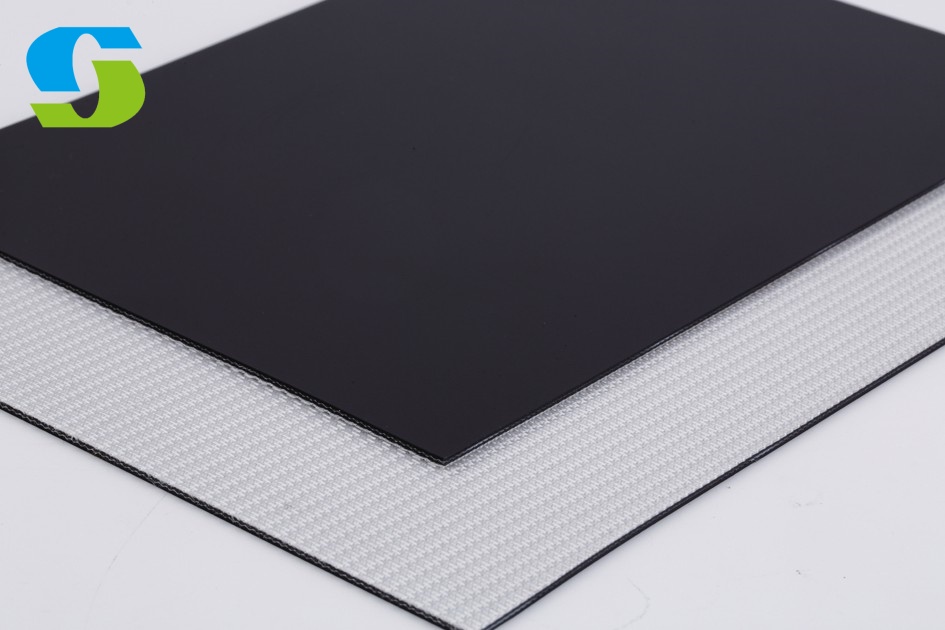
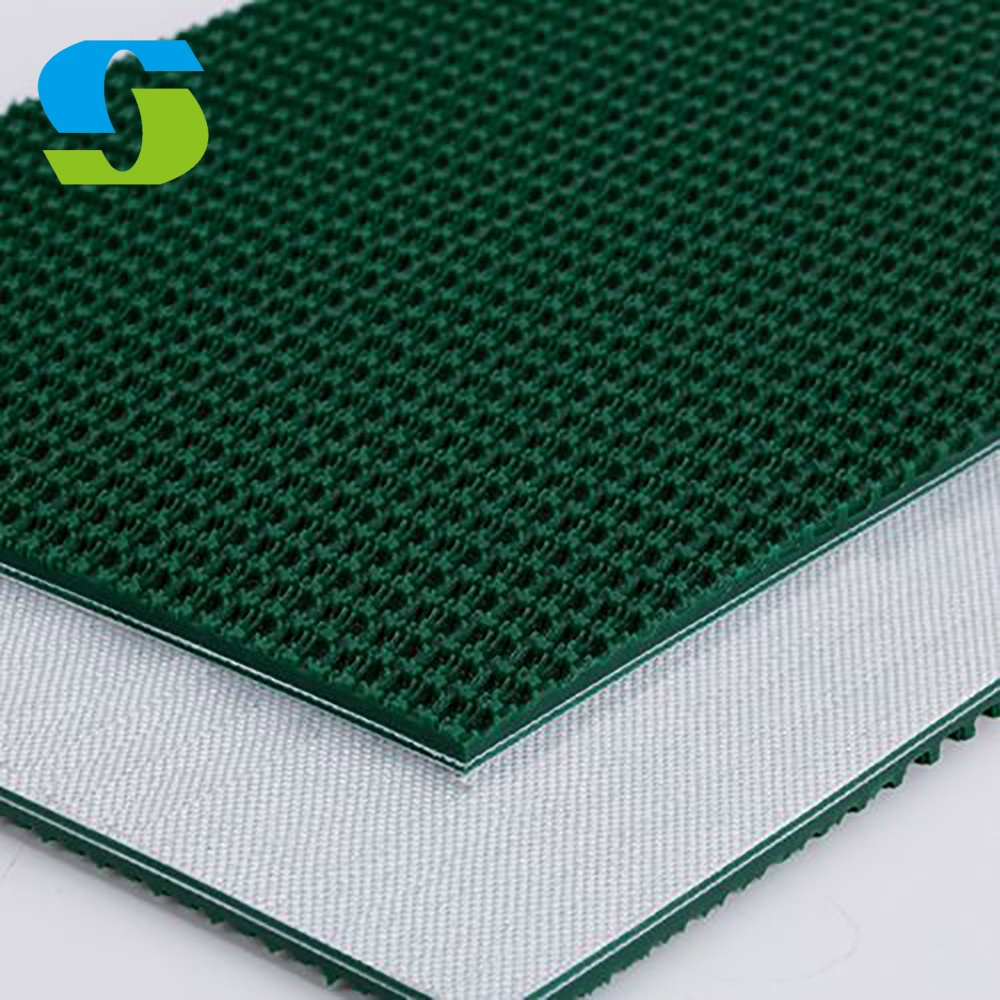
PVC conveyor belts are among the most widely used solutions for light-duty automotive manufacturing operations. Constructed from polyvinyl chloride coatings reinforced with polyester fabric, these belts offer excellent wear resistance, dimensional stability, and cost efficiency.
Their smooth surface facilitates easy cleaning while providing sufficient friction for transporting lightweight automotive components.
Typical applications include:
- Electronic component assembly
- Plastic interior parts
- Packaging lines
- Small component transportation
- Quality inspection stations
PVC conveyor belts are particularly popular because they balance durability, affordability, and maintenance simplicity.

Bandes transporteuses en PU
Polyurethane (PU) conveyor belts are designed for applications requiring higher abrasion resistance, superior flexibility, and enhanced chemical resistance compared to PVC belts.
PU materials exhibit excellent resistance to oils, greases, and many industrial chemicals commonly encountered in automotive manufacturing environments.
Additional advantages include:
- High tensile strength
- Excellente résistance à l'usure
- Low particle generation
- Smooth operation
- Superior flexibility
- Long service life
These characteristics make PU conveyor belts suitable for precision assembly lines where cleanliness and durability are critical.
Common automotive applications include:
- Precision component handling
- Electronic module assembly
- Battery manufacturing
- Interior trim production
- Automated robotic cells

Rubber Conveyor Belts
Rubber conveyor belts remain the preferred choice for heavy-duty transportation within automotive manufacturing plants.
Their reinforced multi-layer construction enables them to carry heavy loads while absorbing impact and vibration generated by large components.
Rubber conveyor belts are commonly used for:
- Steel coil transportation
- Stamped body panels
- Engine blocks
- Transmission components
- Chassis assemblies
Depending on production requirements, manufacturers may select rubber compounds optimized for:
- Heat resistance
- Oil resistance
- Flame resistance
- Abrasion resistance
- Static conductivity
These specialized formulations ensure reliable performance under demanding industrial conditions.
Modular Plastic Conveyor Belts
Unlike continuous belt designs, modular plastic conveyor belts consist of interlocking plastic modules connected by hinge rods.
This modular construction provides several engineering advantages:
- Damaged sections can be replaced individually.
- Excellent drainage capability.
- High corrosion resistance.
- Flexible conveyor layouts.
- Easy maintenance.
Modular belts are increasingly used in automated automotive factories because they accommodate complex conveyor paths, including curves, inclines, and spiral configurations.
Typical applications include:
- Painting lines
- Washing systems
- Component cooling
- Packaging operations
- Automated logistics systems
Timing Belts
Timing belts differ from traditional conveyor belts because they synchronize motion with exceptional positional accuracy.
Equipped with molded teeth that engage matching pulleys, timing belts eliminate slippage and maintain precise positioning throughout operation.
This accuracy is particularly important in:
- Robotic assembly
- Pick-and-place automation
- Vision inspection systems
- Precision positioning equipment
- Automated fastening stations
As automotive production increasingly relies on robotics, timing belts have become essential components in automated manufacturing systems.
Metal Mesh Conveyor Belts
Metal mesh conveyor belts are specifically designed for environments involving high temperatures, aggressive chemicals, or heavy-duty processing.
Manufactured from stainless steel or alloy wire, these belts provide:
- Exceptional heat resistance
- Excellent airflow
- High structural strength
- Résistance chimique
- Long operational lifespan
In automotive manufacturing, metal mesh conveyor belts are commonly used in:
- Heat treatment furnaces
- Drying ovens
- Paint curing systems
- Component washing lines
- Powder coating operations
Their open structure promotes efficient heat transfer and drainage while maintaining mechanical stability.
Comparison of Automotive Conveyor Belt Types
|
Type de bande transporteuse |
Main Material | Typical Automotive Application | Primary Advantages |
|
Bande transporteuse en PVC |
PVC + Polyester | Electronics, inspection, packaging | Economical, easy cleaning |
|
Bande transporteuse en PU |
Polyurethane | Precision assembly, battery production | High wear and chemical resistance |
|
Rubber Conveyor Belt |
Reinforced rubber | Heavy components, steel parts |
High load capacity |
| Modular Plastic Belt | Engineering plastics | Painting, washing, logistics |
Easy maintenance and flexible layouts |
| Timing Belt | Rubber with reinforced cords | Robotics and positioning |
Precise synchronization |
| Metal Mesh Belt | Stainless steel | Heat treatment, drying, curing |
High-temperature resistance |
Each belt type addresses different engineering challenges, making proper selection essential for maximizing manufacturing efficiency and equipment reliability.
Key Factors When Selecting Conveyor Belts
Rather than focusing solely on purchase cost, selecting the appropriate conveyor belt involves evaluating multiple technical and operational factors.
Important considerations include:
- Load capacity
Heavy vehicle bodies and engine assemblies require belts with high tensile strength and structural stability, whereas lightweight electronic components can be transported using thinner, more flexible belts.
- Operating environment
Factors such as temperature, humidity, oil exposure, chemicals, dust, and cleaning procedures can all have a significant influence on belt material selection.
- Belt speed and precision
High-speed automated production lines require conveyor belts with excellent dimensional stability and minimal elongation to ensure accurate positioning and synchronisation with robotic equipment.
- Maintenance requirements
Factories are increasingly prioritising conveyor systems that minimise downtime. Modular plastic belts, for example, allow damaged sections to be replaced individually, thereby reducing maintenance costs and improving production availability.
- Energy efficiency
Modern conveyor systems use low-friction materials and lightweight designs to reduce motor power consumption while maintaining consistent performance.
Automotive Conveyor Belt Applications Across the Production Line
Different stages of automotive manufacturing impose different mechanical, thermal, and chemical demands on conveyor belts. Selecting a belt based on its intended application improves production efficiency, minimizes maintenance, and supports consistent product quality.
- Stamping and Press Shop
The stamping department handles heavy steel or aluminum sheets that are transformed into body panels through high-tonnage presses. Conveyor belts used in this area must withstand substantial impact loads, abrasion, and occasional exposure to lubricants.
Heavy-duty rubber conveyor belts are commonly selected because they provide excellent tensile strength, shock absorption, and long service life. In automated transfer systems, timing belts may also be integrated with robotic handling equipment to achieve accurate positioning.
- Body Shop and Welding Lines
After stamping, body panels move to robotic welding stations where precision is essential. Conveyor systems must synchronize with industrial robots to ensure accurate positioning during spot welding, laser welding, and assembly.
Timing belts and precision PU conveyor belts are frequently used because they provide stable movement with minimal slippage. Their dimensional stability helps maintain production accuracy while reducing alignment errors.
- Paint Shop
Paint shops present one of the most demanding environments for conveyor systems. Conveyor belts may encounter cleaning chemicals, moisture, elevated temperatures, and curing ovens.
Modular plastic conveyor belts and stainless-steel mesh belts are widely used due to their resistance to corrosion, ease of cleaning, and ability to withstand high-temperature drying and curing processes. Their open structures also facilitate drainage and airflow, improving coating quality.
- Final Assembly
Vehicle assembly lines transport engines, dashboards, seats, doors, wiring harnesses, and countless other components before complete vehicles undergo inspection.
PU conveyor belts are often preferred in these environments because they combine excellent wear resistance with smooth surfaces that help prevent scratches on painted components. Their resistance to oils and cleaning agents also supports long-term reliability.
- Logistics and Warehousing
Finished components and spare parts must be transported efficiently within warehouses and distribution centers.
PVC conveyor belts are commonly used for carton handling, packaging, and lightweight material transport due to their economical cost, stable performance, and easy maintenance. Larger logistics systems may integrate conveyor belts with automated storage and retrieval systems (AS/RS), barcode scanners, RFID readers, and warehouse management software.
Conveyor Belt Selection Guide for Automotive Manufacturing
|
Processus de fabrication |
Recommended Conveyor Belt | Primary Selection Reason |
|
Metal stamping |
Rubber conveyor belt | Heavy load capacity and impact resistance |
|
Robotic welding |
Timing belt / PU conveyor belt | High positioning accuracy |
|
Paint pretreatment |
Modular plastic belt |
Chemical resistance and drainage |
| Paint curing oven | Metal mesh conveyor belt |
High-temperature resistance |
| Final vehicle assembly | Bande transporteuse en PU |
Surface protection and durability |
| Packaging and warehouse logistics | Bande transporteuse en PVC |
Cost-effective, stable transport |
This guide illustrates that there is no single conveyor belt suitable for every production stage. Instead, manufacturers typically employ multiple belt types throughout the same factory to optimize efficiency and reliability.
Common Challenges and Maintenance Best Practices
Even high-quality conveyor belts require regular inspection and preventive maintenance to ensure they perform optimally. Common operational issues include misalignment of the belt, uneven wear, contamination, insufficient tension, and damage to the pulleys.
To maximise service life, manufacturers should implement a preventive maintenance programme that includes the following:
- Routine inspection of belt tracking and alignment;
- Cleaning to remove oils, dust, and production residues;
- Monitoring belt tension according to manufacturer specifications;
- Inspecting pulleys, rollers, and bearings for wear;
- Replacing damaged belt sections before failure occurs;
- Maintaining proper lubrication of mechanical drive components where applicable.
Predictive maintenance is also becoming increasingly common. By integrating sensors that monitor belt speed, vibration, temperature, and motor load, manufacturers can detect abnormal operating conditions before unexpected downtime occurs.
Industry Trends: Smart Conveyor Systems
As the automotive industry embraces Industry 4.0, conveyor technology is evolving from basic transportation equipment to intelligent production infrastructure.
Modern conveyor systems increasingly incorporate the following technologies:
- IoT-enabled condition monitoring
- AI-assisted predictive maintenance
- Digital twin simulation
- Real-time production analytics
- Energy-efficient drive systems
- Automated fault diagnostics
These technologies allow manufacturers to optimise production scheduling, reduce maintenance costs, and enhance equipment availability.
Another important trend is the development of environmentally friendly conveyor belt materials. Manufacturers are investing in recyclable polymers, low-energy production methods, and more durable belt designs to support sustainability initiatives and reduce total lifecycle costs.
Choosing the Right Conveyor Belt Supplier
Beyond selecting the correct belt type, choosing an experienced supplier is equally important. Automotive manufacturers typically evaluate suppliers based on product quality, customization capability, technical support, delivery reliability, and compliance with international quality standards.
Wuxi Shunsheng Industrial Belt supplies conveyor belt solutions for industrial automation and manufacturing applications, offering products designed for demanding operating environments. When selecting a supplier, businesses should consider factors such as belt material, tensile strength, operating temperature range, surface finish, joint options, and compatibility with existing conveyor systems to ensure long-term operational reliability.
Frequently Asked Questions (FAQ)
- What are the main types of conveyor belts used in automotive manufacturing?
The most common types are PVC conveyor belts, PU conveyor belts, rubber conveyor belts, modular plastic conveyor belts, timing belts, and metal mesh conveyor belts.
- Which conveyor belt is best for heavy automotive components?
Rubber conveyor belts are generally the preferred choice because of their high tensile strength, durability, and ability to absorb impact from heavy loads.
- Why are PU conveyor belts widely used in assembly lines?
PU conveyor belts offer excellent wear resistance, flexibility, oil resistance, and smooth surfaces that help protect painted or precision automotive components.
- Where are metal mesh conveyor belts commonly used?
They are typically used in paint curing ovens, heat treatment furnaces, component washing systems, and other high-temperature manufacturing processes.
- How can conveyor belt service life be extended?
Regular inspection, proper tension adjustment, cleaning, pulley alignment, and predictive maintenance programs significantly improve conveyor belt lifespan.
- What factors should be considered when choosing a conveyor belt?
Important considerations include load capacity, operating environment, temperature, chemical exposure, belt speed, positioning accuracy, maintenance requirements, and overall lifecycle cost.
Conclusion
Modern automotive manufacturing relies on a variety of specialised conveyor belts, each designed to meet specific production needs. For example, PVC conveyor belts are ideal for light-duty operations, PU belts support precision assembly, rubber belts can handle heavy industrial loads, modular plastic belts simplify maintenance, timing belts ensure accurate positioning, and metal mesh belts perform reliably in high-temperature processing environments.
Instead of asking which conveyor belt is ‘best’, manufacturers should consider production conditions, load characteristics, environmental exposure, maintenance strategy, and automation requirements. Selecting the right belt improves productivity, reduces downtime, extends equipment life, and ensures consistent product quality throughout the manufacturing process.
As automotive factories continue to adopt smart manufacturing technologies, conveyor belts will play an increasingly important role in connected, data-driven production systems that prioritise efficiency, reliability, and sustainability.